Showing posts with label cheese. Show all posts

Tuesday, January 22, 2013

Yasa vineyards, old vines Macabeo

http://www.kysela.com/spain/virgendelaSierra.htm

I recently purchased a bottle of wine at auction on a whim... the subject was a non-vintage bottle of a Spanish varietal that I rarely, if ever, see as a single-varietal in this part of Western Canada: Macabeo. I knew very little about the varietal other then it's use in northern Spain for one of my favorite sparkling wines; Cava.

So I bid, I won, and I took it home. The bottle was very inexpensive and I thought to myself "Meh. How bad can it be?"

Turns out, it's brilliant. So brilliant that I saved my last half-glass in the fridge for over two weeks, and even without vacu-vin, it's still superb. How can this be you wonder? Well let me tell the tale~!

the Calatayud region
Spanish winemakers have had a rough go of it for decades... only just recently have they come back into favor. And so in Calatayud, northern Spain, in the 1950's banding together was really all the little producers could do to stay afloat. Hence the creation of the Virgen de la Sierra co-operative in 1954. They have 579 members, and fight to produce quality wine in a place that for many people must look barely inhabitable.

Not so to the grapevine~! This stony, loose soil - so poor in nutrients - is perfect for the grapevine. Not only does it not mind that it has to find moisture, it loves it. Remember that; grapevines are like people... always thriving because of challenge, not despite it!

Macabeo vine; 50 years or older
Anyways. This stony soil is quite loose, which allows the vines a bit of an easier time to push down, down, down to the iron-rich deposits below and the sacred water. In fact, it was the local name for the dry creek-beds that gave the name to this wine: Yasa. These vines thrive, and find all that they need in the dry and dusty high-altitude valley. Just look at this vine, bent with age... no machine has ever touched it - this is entirely worked by hand and has been for decades. The average age of the Macabeo here are over 50 years... and whilst many New World producers would charge dramatically higher prices because of the vine age, this co-op does not.

They have my thanks.

And they have my thanks for showing me what this brilliant little varietal is capable of! I've discovered that the best white Riojas which sell for upwards of $100 or more in my market, are made with top level Macabeo and aged sometimes for decades (I have one in the cellar right now from 1991). But then, why am I surprised? 

This is the age of the wine-consumer; never before have we been able to enjoy such quality, such diversity, and at such extraordinarily low prices. True enough, there is mass-produced, chemically-enhanced, bag-in-a-box swill as never before, but for those willing to look in dusty corners, and try something other then the norm - treasures abound! 

The co-op winemakers of Calatayud display quality and precision in their winemaking. They also display a high level of honor in how they treat their land, their vines. These are the types of winemakers who excite me and make me want to try more! And when they hawk their wares for a more then reasonable price? Then I'm willing to try just about anything they care to sell.


n/v Yasa old vines Macabeo
$9.99 USD,   88 points
Kysela Pere et Fils importers

varietal:   100% Macabeo, 50 years or older
altitude:    850 metres to 1000 metres
soil:     poor, stony, loose; high iron-content, clay sub-surface
  • visual:   clean; light golden-amber core with bright silver highlights
  • nose:   clean; moderate+ intensity of youthful aromas; very precise minerality, crisp and clean, lime juice, tree resin, light musk
  • palate:   clean; dry, full lime acids, light body, moderate+ ABV (13.5%), moderately intense youthful flavors mimicking the nose with an extremely focused though not developed minerality throughout, sharp citrus tones mixing with a light floral background. Very good balance and structure. Good length
  • conclusion:   A cheeky little devil, this is a playful Tuesday wine with spirit and substance. This wine has it's own character and will not be confused easily with other wines in it's pricepoint! Worth buying a case, it will not develop further in bottle. Drink 2013-2015
  • FOOD PAIRINGS:   crisp acids call for some fat, and the minerality with play off seafood. Consider Oysters rockefeller!!! The above mentioned is self-explanatory, but the bacon in a good Rockefeller will bring the savory qualities out from the wine and make it even more like a northern Rhone white then it already is.

And so, from this quiet part of northern Spain comes a value wine that truly has value. And so much of that part of Spain is in the wine: it has kept it's bright acids because Calatayud is a continental climate: they have hot summers, cold winters, but above all they have a marked change in temperature from day to night. Hot summer days and cool summer nights preserve the acidity in wine. The soil I can still taste, and find impressive in such an inexpensive wine. But then there is the last part of what we call terroir that I can't explain, not yet. That is the people... but I dearly want to meet the people who work so diligently to coax wine from old vines in a parched part of the world. Yes, I want to meet those people and shake their hands.

As always, I look forward to your comments and questions.

CINCIN~!!!     SLAINTE~!!!     CHEERS~!!!

Wednesday, November 14, 2012

Il Bisserino; sparkling red wine of Milano


Milano, Italy

When most people think of Milano, Italy, they think of fashion, of culture, of historical edifices. Most think of Milano as one of the great cities of Europe, enshrouded in the Autumn fogs that roll in from the coast.

But they don't think of winemaking. No, most people certainly don't think of that.

Oh it's not that the Milanese don't drink wine (they most assuredly do). The thing is that, up until the (relatively) recent past - for all of Milan's history - there was no local history of great winemaking...

For it was just in 1984 that Milan got it's first officially recognized wine producing region: colle de San Colombano, DOC. A region just south of the city, there has been wine production in these low, rolling hills for centuries upon centuries but, alas, mostly table wine (vino di tavolo). Now in the "Golden Era" of wine, technology is growing by leaps and bounds and eonophiles are quick to jump on board.

Lodi; in which one finds San Colombano
With new trellising methods, better understanding of soil compositions and infinitely cleaner methods of production, even the everyday wines of today are miles beyond what they were only a few decades ago.

Case in point, a charming little frizzante or sparkling wine from Claudio Pozzi: Il Bisserino (http://www.ilbisserino.it/). Fresh, fun, bursting with fruity goodness and a savory edge from the calcareous soils of the region, this is the sparkling wine for the person who adores big juicy reds and swears they abhor Champagne.

Indeed, Claudio and his team are doing something that winemakers the world over are trying to do though not all are succeeding: create value wines with a sense of place. But Claudio doesn't come by his talent honestly, at least, not in the old-fashioned sense of the term. Claudio never grew up in the vineyards and his father never taught him how to crush grapes. He is the first of his name to enter the winemaking arena and, in fact, still maintains another career.

So then to what can we attribute this wineries competent line of wines, at reasonable prices, with a sense of joy and characteristics of skill? Well if it's not inherited skill then it must be cultivated skill~! And where do we most often derive cultivated skills from? From passion!

Claudio speaks of the wonder and beauty he derives from his new craft, of a desire to create a vineyard that works with farming practices that have a true sense of purpose rather then blindly following an organic system to "sell more labels". To call Claudio a visionary would be stretching the truth, but rather let me say that in My Humble Opinion, Claudio Pozzi is doing what I hope all winemakers can aspire to: a truly Henry Ford style of business.

 "There is one rule for the industrialist and that is: Make the best quality of goods possible at the lowest cost possible, paying the highest wages possible"

2007 Il Bisserino Vin de Milan, San Colombano DOC
$20+ USD (the Tamalpais Wine Agency of California)
not widely available in Canada
89-90 points

vine age:   35+ years
vineyard size:   2.5 HA
altitude:    100 metres
soil:          clay silt
varietals:    Croatina 40% -Barbera 35%-Uva Rara 15%-Cabernet Sauvignon 10%
harvesting:   manual, end of September
vinification:   8-10 days maceration in stainless steel. Malolactic fermentation
  • visual:   clear; deep plum garnet core with light cherry rim, small amount of tiny pearl bubbles
  • nose:    clean; moderate+ intense youthful aromas of candied cherry, blackberry, red currant, dark cherry blossom characteristics, some violets
  • palate:   clean; dry, moderate+ (red currant) acids, moderate+ (chalky) tannins, moderate- body, moderate- alcohol (13.5%), moderate intense and developing flavors that mimick the nose; candy notes are gone and replaced by savory earthy tones, warm brambleberry/saskatoon flavors, lean graphite minerality and a crisp red currant finish... almost drinks like a young Morgon or Moulin-a-Vent. Very good balance and structure, medium length
  • conclusion: already almost 6 years old, this wine is still in the prime of life and easily has another 3-5 years left but will not develop appreciably
  • FOOD PAIRINGS:   much as Claudio says on his website, this wine will cosy up to a plate of cured salami and provolone cheese with delight, but I thought to take this one step further. What about prosciutto, prawn and chevre pizza? The salt of the prosciutto plays off the sweet fruit on the nose, the prawns will delight in the cherry flavors and the chevre will enhance the natural earthy tones!


Take a gander through the Il Bisserino website, or read some of Claudio Pozzi's interviews, and you will come to understand how that man came to this industry as an outsider. But, as an outsider, has no issue with "bucking the system" and throwing outdated traditions out the window. Claudio's staff are well paid, his lands are well taken care of, and his business model is sound. To me, this is the winning combination that will allow his grandchildren the luxury of learning the winemaking industry the old-fashioned way...

They'll learn it from their grandfather.

The proof my friend? As always, in the glass!

I look forward to your comments and questions.

CINCIN~!!!     SLAINTE~!!!     CHEERS~!!!

Monday, August 27, 2012

Pouilly-Fume, "Les Cris", Domaine A. Cailbourdin, Loire Valley, France

Let's pretend that you're in Paris; you decide to leave the hustle and bustle of the big city for an afternoon in the country and where better to go then the Loire Valley?? 

   You drive for about an hour or so due south and hit the metropolis of Orleans; famed for it's rich cuisine, crisp wines and beautiful women. Try, if you can, to stay in your car and follow the motorway east... the road follows the Loire river as it meanders east, quickly dipping it's way south. Soon you're heading due south and could easily cross the river for a bite to eat in Sancerre

   But let's say that today you decide not to cross the river. Just a kilometer off of the motorway, within a few hundred feet of the river, is the hamlet of Tracy-sur-Loire and it is here that we find the winery Domaine A. Cailbourdin ( www.domaine-cailbourdin.com ). A nicer place for a picnic you would be hard-pressed to find.

  
  The hillside rolls gently down, covered with a rich canopy of grapevines, interspersed with small thickets of forest. Pear trees are hanging heavy with fruit and the perfume of the cherry trees invites one to an afternoon of idolentry; some fresh bread and cured meats, a little block of chevre and a chilled bottle of local Sauvignon Blanc. For that indeed is what varietal is going into the wines of Puilly-Fume, and that is where you have found yourself. 

   And it was only a few decades ago that Alain Cailbourdin found himself in this same spot, looking at the same vines, deciding that it was here that he would build a future. Thus the inception of Domaine Cailbourdin, with some truly vielles vignes  or "aged vines" of 50+ years, and the more recently planting going back to 1980.
Alain Cailbourdin

   Alain built this winery on solid principles; one of the greatest being a respect for the land. In his own words "The art of the winemaking profession consists of giving the grapes every possible opportunity to reveal their qualities."

   Amen Alain!

   Of course, this isn't the first time that I've heard a winemaker say these words. But, in the Loire Valley and in Pouilly-Fume, these words take on a high degree of clarity.

   Some of you reading this will already know that the Fume  part of the name for this region comes from the smokey nuances given to the wines here from the high levels of Silex in the soil. This region produces 100% Sauvignon Blanc, almost 100% of which is fermented and matured in stainless steel. Why is this important? Because this, too, goes to demonstrate the regions strict adherence to allow the land to express itself fully through the varietal.

   But let's return to Alain's words and consider them carefully. Firstly he uses the word "art" most particularly. That could be a point of contention for many people as winemaking can be as much of a craft as an art and, to be brutally honest, we've all had examples that were terribly shy on craft. So then why use the word "art" for a $20 bottle of wine?

   I think that it must be because of the high level of skill used in Alain's vineyards every day to reach the point where the grapes can start to tell their story. One could say that it starts with the trellising (which came first, the trellis or the grape?). Alain has restored a traditional, yet rarely used, method known as Le Cordon de Royat  which is more labor intensive than Guyot simple, yet allows the vine more room for the grapes to expose themselves to sunlight. This allows for greater ripeness, and also reduces the risk of mildew issues.
Sauvignon Blanc grapes

   And should mildew become an issue, how do Alain and his son Loic deal with them? For a winery not certified as organic, the two spend a great deal of time talking about the natural rhythms and patterns of their vineyards; they speak of the care and attention paid to bud-growth in Spring, planting grasses betwixt the rows of vines, of careful canopy management in Spring and Summer... they speak like organic winemakers. They speak with bio-dynamic principles at work in their fields. And why such ardour?

   "because our vineyard constitutes not only our livelihood but our way of life from day to day; it is the heritage we hope to leave our children" says Alain.

   And well how does this families' effort translate into action? As always, the proof is in the glass:

2010 Pouilly-Fume "Les Cris"
$20+ USD
$32+ CAD (BC)
89-90 points 

*previous vintages have scored gold medals at the Concours D'Angers and the Concours Generale Agricole de Paris
*this winery has ranked in the top 150 producers of Sauvignon Blanc  in the world (www.WineSpectator.com)
  • visual:   clear; pale straw core with light gold and green highlights
  • nose:   clean; medium intense youthful aromas thick with minerality, warm straw, baked apple... very fresh, crisp, clean and precise with the trademark smokey, almost peppery, finish
  • palate:   clean; dry, fully intense (yellow grapefruit) acid, moderate- ABV (13%), medium- body,  medium+ intense and youthful flavors mimicking the nose with more emphasis on citrus; lemons, limes, grapefruit, even tangerine are felt. The minerality is tight but opening delightfully. Very good balance, good structure and medium+ length 
  • conclusion: whilst already showing well, this still has room to develop. Drink 2012-2015 for best results
  • FOOD PAIRINGS:   Sauv blanc is, of course, a natural for fish. Consider a somewhat fatty fish like trout, Artic Char, salmon and the preparation can be as simple as pan-frying with butter! When using a leaner fish and a lean wine like this, consider finishing a hint of cream, such as baked Great Northern Pike with butter-braised leeks, steamed new potatoes and grilled sweet peppers
  
Domaine Cailbourdin

   But now I've painted myself into a corner as-it-were! Here I was talking about technical matters to support a claim for artistry. Perhaps, then, that is where the art is found; in the technical routines that encapsulate this ancient craft. It is art: in calling each of Alain's four plots of land by it's own name (Boisfleury, Les Cris, Les Cornets, Triptyque), so that we can come to sense the differences in soil composition, in aspect and slope, but most of all in place. For it is Alain's wish and, as eonophiles, it is ours as well, that we will come to appreciate as much as he does the place that he calls home.

As always, I welcome your comments and questions.

CINCIN~!!!     SLAINTE~!!!     CHEERS~!!!

Tuesday, March 22, 2011

Lustau Dry Amontillado, Los Arcos Sherry

I didn't think that I would be writing an article about sherry production, but how does one write about sherry without talking about production?

   The world of sherry is a new an exciting one to me, being from Western Canada. Sherry consumption (such little as there is) is usually reserved for old matriarchs who sip contentedly during Christmas on a dram of Harvey's Bristol Cream. Far be it (very far indeed) for me to put forward my much maligned notions on cream sherry, but suffice it to say that I have never been, nor expected myself to become, a sherry drinker.

   At least, not until I myself come a matriarch, which I consider most unlikely.

   Lo and behold, "the times they are a'changin". I have consumed sherry, willingly, and enjoyed it! I had an upcoming lecture and, as always, fear of being embarrassed by my lack of knowledge made me pick up a few bottles at my local BC Liquor Store (http://www.bcliquorstores.com/).

   First on the hit-parade was a little number known as a dry Amontillado, and here is when I must say a little something about sherry production.


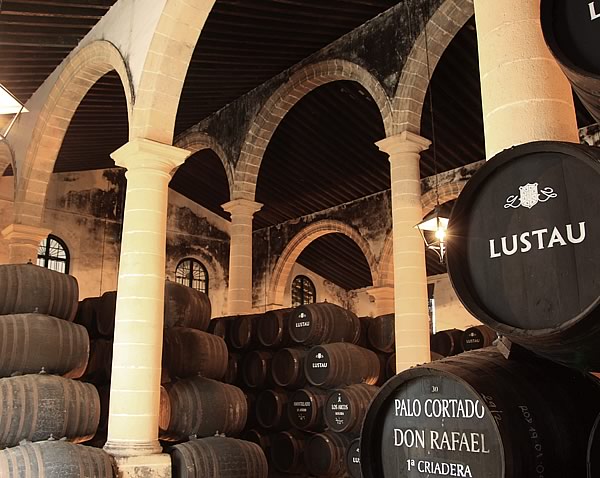
Lustau casks

   Firstly, sherry is made using a method of production known as the solera-system. This is a system by which three layers of large barrels are stacked on top of each other. The top layer is the youngest aged sherry, the bottom layer is the eldest. Each bodega or winery has it's own system, but in general every 4 months to 2 years the bodega will move about 15% of the wine down to the next level. The wine then takes on the characteristics of the older wine in the barrel, and magic is made. When the sherry is ready to move on from the bottom level, it's time to put the magic in a bottle.

   An important part of the magic however, lies inside of the sherry casks themselves. Sherry comes from a very moist part of Spain... yeasts and molds are abundant thankfully. I say "thankfully" because one of those yeasts lives inside of the sherry casks. It is responsible, in large part, to giving fine sherry it's distinctive flavors and aromas. Amontillado starts it's life with that flor or yeast, but then the flor dies and what is left behind begins to oxidize in a completely beautiful way.


Lustau reserva Dry Amontillado, Los Arcos Sherry
Jerez de la Frontera, Jerez D.O., Spain
18.5% ABV, $15 (375 ml)    **Very Good Value**
  • visual:   clean; moderate+ caramel core with slight watery rim
  • nose:   clean; moderate+ intense developed aromas of toasted almonds, soft wildflowers in the background, rich sea salt, raw walnuts
  • palate:   clean; ultra-dry, moderate+ (young crabapple) acids, moderate+ ABV, moderate+ body, moderate+ intense developed flavors of lemon and yellow grapefruit zest, toasted and raw almonds and walnuts, slight white pepper finish, sea salt, light caramel nuances. Very good balance and structure, excellent finish (for the price)
  • conclusion:   Great value for the money. Enjoy now - cellaring will have no effect
  • PAIRINGS:   popular opinion is to serve this with a beef consume. While I can envision the wisdom of this, I would add some heirloom tomato and fresh pasta... but please, enjoy this wine in the warmth! This is not a wine made for cold weather, at least, not for an Irishman like myself
   So I learned a little something, tried something new, and still got to prepare for my lecture. Sherry really is something special, and has it's own type of magic in the fermentation world. Most sherries are aged for years before they make it to market, and I have in the past been reluctant to give a few moments to taste a new sherry instead of returning to a wine I know. Who am I to be so reluctant with a few moments when someone has dedicated years for my eonological pleasure?


Lustau bodega in Jerez de la Frontera

As always, I welcome your questions and comments.

CINCIN~!!!     SLAINTE~!!!     CHEERS~!!!

Sunday, July 4, 2010

English Harbor Aged Rum, Antigua


Well it's not often that I review rum, but as Fall turns to Winter and masks itself as Summer, I find myself sitting by a roaring fireplace more and more.

We had good friends over to the house just last night in fact! One of them, Jay, is as much of a cigar fan as I am and we both had Cuban Cohiba Esplendidos. Of course, that was when the rum came out and the conversation became even more relaxed.

English Harbor Rum is quite new to the rum scene; whereas some Cuban distilleries can trace their history back several centuries, EHR created it's first dark rum in the 1950's, and only started importing to North America in 2004.

And praise has fallen upon them! Two double-gold awards at the San Francisco Spirits Competition in 2004 and 2005 and, IMHO, worthy of those honors.

English Harbor, 5 year aged rum, Antigua
40%, $31 (BCLCB), **very good value**
  • pale caramel/amber color
  • moderately intense nose of caramel, heather, oak, vanilla, apples
  • moderate+ intense flavors that mimic the nose... palate starts with the caramel apples, oak/vanilla/heather and slight peaty-acidic finish
This rum almost drinks like an Irish whiskey: think Tullimore Dew rather then a Bushmills. That touch of sweetness isn't overpowering, but rather compliments the slight orchard fruit and herbaceous floral notes. A wonderful pairing for a medium cigar, it may pale beside a robusto or even slightly overpower a mild cigar such as a Davidoff.

Pair it with Cohiba or Macanudo. With food you ask? Try any slightly sweet dessert with nuts; Arabic desserts such as Halva with cheese, pistachio biscotti, almond gelato, etc...

Cin-cin! Slainte!

Monday, June 28, 2010

Sonoran Estates, Summerland, BC


Sonoran estate wineries ( http://www.sonoranestate.com/ ) was a welcome stop on our week long stay in the Okanagan last August. It was over 30C and Mrs Astudentofwine and I had been driving all day, tasting more then a little wine, and needing some respite from the road.

Then we found this brilliant winery in the low hills above Summerland; the patio faces the lake with un-interrupted views and constant breezes. The interior of the wineshop is cool, warmed by the inviting staff, and host to a horde of inexpensive and delicious wines. Now they have a chef, cooking classes, a modest b&b... we have a bottle of their Kerner Icewine that we savored at the end of a long evening of barbeque with family and Belgian chocolate.

A sommeliers natural habitat: finding the perfect wine to balance fine food and great company.

2005 Sonoran Estate "Full Moon" Kerner Icewine
13.6%, $16 (approximately) **Excellent Value**
  • soft golden hues
  • vibrant, fully intense nose of Solera system sherry; lots of raisins, dried apricot, dried apples & butter
  • moderate++ acids balance the 4 sweetness, moderate+ intense palate that mimics the nose almost completely... with a long finish of wild roses not found on the nose
  • full bodied, moderate alcohol, very very good structure
This is a beautiful wine that is still developing (IMHO). Don't serve with sweet desserts! Think of it with a savory appetiser like foie gras (yes - like Sauternes but not $100 a bottle). After dinner? Perhaps with a ricotta cannoli, pumpkin ricotta cheesecake, or just some brilliant cheeses! I drank it a year ago, and since then it has grown new layers if memory serves. I look forward to trying more from this decidedly undervalued winery.

Wednesday, March 24, 2010

Monkey Bay

very very very behind on transcribing my wine notes to the blog so bear with me if some dates don't match up!

A while back I decided that for class I needed to brush up on my knowledge of whites... well some whites I know, and Sauvignon Blanc is not one of them. This is what I've learnt:

Sauv Blanc makes one of my favorite whites - actually two of them. Puilly-Fuisse from France and Fume Blanc (Mondavi) from California... luv em to death. But New Zealand is supposed to be the producer of the best in the world. And no one knew until the 1990's.

WINE A

clear visual
  • very pale straw centre

clean nose, moderately intense notes of

  • vanilla
  • grass
  • crisp green stonefruit (young peaches)

clean palate, 0 dryness, moderate++ acid, 0 tannin, moderately intense flavors of

  • vanilla
  • grass
  • crispy green stonefruit

moderate body, moderate alcohol (12%), very good length

Those who know my wine-notes know that I rarely put the same notes for nose and palate. This was an incredible exception. It tastes like it smells and is incredibly easy drinking. Be warned! A bottle of this can be drunk by one person far too easily! Ok... don't say I didn't warn you.

Pairs well with soft buttery cheeses, creamy pasta or risotto, anything with a bit of heaviness to it will be elevated by this crisp bright acids and young stonefruit of this lovely wine.

2008 Monkey Bay, Sauvignon Blanc, New Zealand **buy this @ $20 or less**

Thursday, February 4, 2010

happy Gruner!

A very good day to all, and happy Gruner!
Gruner is a very neat varietal... not the least reason being that it tastes very minerally (my own word). You all know that I've been grappling with the ability to "taste minerality" or more appropriately "describe a taste in wines as being mineral". So where better to go, than one of the epitomes of minerality.
A luscious grape, primarily from Austria & Czech (where it is 11% of all grapes grown for wine-making it the second highest)... apparently it has beaten world class Chardonnays in blind tastings! Very cool indeed, especially when one considers that it is almost unknown & rarely planted. Check out wikopedia - it tells a bit more.
_________________________________________
WINE A

clear visual, moderately intense of pale lemon

clean nose, moderate- intensity of dust, chalk, mild summer flowers (think dandelions), green grapes

00 dryness, full- acid, 0 tannin, moderate+ intensity in the flavors; chalk, gravel, granite, really under ripe stone-fruit (peaches, nectarines), honey, even a touch of petrol (or am I just over-tired?)

moderate body

moderate alcohol (11.5% but it tastes like 12+%)

full length of palate going 10 seconds and longer
___________________________________________________________________

So what a beautiful wine! I would serve it with mildly roasted chicken or pork (no heavy grilling), sauteed prawns & scallops, soft cheeses like boursin... it was truly a pleasure to drink it, and I feel like I spent $30 wisely.

Thank you again Marquis Wine Cellar!
Cin-cin & slainte!!