Wednesday, January 19, 2011

Falanghina, ancient white wine from Campania, Italy

Some of you may know that Mrs Astudentofwine is of Italian descent. Her father was the first to be born here in Canada, of Calabrese parents, and so she was raised  surrounded by Italian speaking aunts, uncles and grandparents. Very cool for me then to be learning about wines from just up the coast from where her family lived for generations.

     Campania is actually a Latin word, and literally means "the Countryside". There may in fact be somewhat of a stigma against winemaking (not without justification) from "the Countryside" but - just as with most regions of the world - here as well great strides in quality are being made. And what better place to start then this magnificent anicent grape Falanghina, native to Campania, and capable of rich aromatic white wines that pair as well with seafood as they do with a crisp pizza topped with buffalo mozzarella? Both pairings, by-the-way, are in fact regional. Did you know that the pizza (as we know it now) was first made in Napoli, capital city of Campania?


     Well anyways, Falanghina has 15 pseudonyms (which I will not bore you with) which makes it a horror for any student to try to learn about. It also has a plethora of rich possibilities in the bottle, which makes it an absolute pleasure to drink. Did I mention that it's also reasonably priced?

2009 Falanghina, by Terredora
Campania, Italy (Indicazione Geografica Tipica)
13% ABV, $20   **EXCELLENT VALUE **
2008: Decanter Awards 2009 – silver
         The International Wine Challenge 2009 - bronze
2007: Decanter Awards 2008 – bronze
         The International Wine Challenge 2008 – bronze
         Vinitaly 2008, Concorso Enologico Internazionale – commended
2006: Decanter World Wine Awards 2007 – bronze
         The International Wine Challenge 2007 – commended

  • visual:     clean; moderately intense golden lemon core paling to watery rim
  • nose:     clean; moderately intense young and vibrant aromas of minerality, wild grasses, mild exotic fruit such as pineapple, almondy lees
  • palate:    clean; 0 dryness, moderate+ Amalfi lemony acids, moderate- body, moderate+ ABV, moderate+ intense youthful and somewhat layered flavors comparable to the nose; Amalfi lemons, wild flowers, strong minerality throughout the palate, lemon finish with a hint of peppery arugula. Very good balance, good structure and moderate+ finish
  • conclusion:   A wonderfully crafted "table" wine that is drinking superbly now (through 2012)
  • PAIRINGS:   Seafood (as they do in Campania). Scallops in a buerre blanc are a natural, as would be butter poached lobster, fresh pan seared trout.... just about anything that is white from the ocean will love this. Herbs would be dill, tarragon, basil (but be sparing and try Thai basil). I personally would stay away from spice as it may throw the wine out of balance
     If anything, this small taste of Campania and the Amalfi Coast has made me more eager then before to take some time to visit Italy. Until then, I'll just have to try different varietals from the region, and from Terredora wines.

CIN CIN~!!!   SLAINTE~!!!   CHEERS~!!!

Saturday, January 15, 2011

Folonari, Valpolicella D.O.C.


the Dolomites

One could easily be confused if one thought this view was the view from somewhere in BC; Whistler perhaps? Pemberton? In fact it is from the northern part of Italy in the area known as Veneto. We here in North America are most familiar with Venetos most famous city: Venice.

     Well I'm not going to talk about Venice, but I am going to talk about something soft, lush, and faintly romanticfrom that same region: the Valpolicella D.O.C.

     Well Valpolicella is capable of greatness... just ask anyone who has ever has a beautifully aged Amarone. But just because it is capable, that doesn's mean that it always achieves.

      Unfortunately for wine-lovers (in some respects), there are few regulations in Valpolicella that do anything to minimize the yields in the vineyard. Quite the opposite, the lands to the North and West of Venice are composed of incredibly fertile volcanic soil and this is the regions cash-cow. Thus, regulations in the area in fact do their utmost to maximize yields from the vineyards. While this does indeed achieve the short-term goal of creating income and taxes, it does little in the long term to set this beautiful land apart from other parts of the world working towards the same goal.

     One would think, in the light of the emergence of the South American wine market, that winemakers in Europe would be working their utmost towards trying to make a wine that spoke more about its terroir rather then less. Why make a wine that could (almost) be from anywhere? What's the incentive for the purchaser? But I digress...

     Folonari vineyards has been in operation under the Folonari family since 1825. The guiding principle (according to the website) seems to be one of "making wine approachable; both in price and in drinkability". Well - it certainly seems as though they have succeeded.

2008 Folonari Valpolicella D.O.C.
Veneto, Italy
65% Corvina, 25% Rondinella, 10% Molinara
12.5% ABV, $19 CAD    **Decent Value**
  • visual:   clean; deep ruby core paling to cherry rim
  • nose:     clean; moderately intense youthful and monotone aromas of bright red berries such as cherry, strawberry, some rhubarb and red candy
  • palate:   clean, 0 dryness, moderate+ to full crabapple acids, moderate slightly green and grippy tannins, moderate body, moderate+ ABV, moderate+ intense youthful, fresh, vibrant flavors mimicking the nose; cherry, raspberry, red candy. Fairly well balanced, average quality structure, average finish
  • conclusion:   If you buy this - drink it now because aging won't do a thing to improve it. Want to improve it? Serve it with food.
  • PAIRS WITH:   Cheap table wine pairs with cheap table food... home-made burgers, pizza, pasta bolognese... perhaps it would be more fair to say that simple table wines pair best with simple table food
     So not a wine to learn anything really about Veneto, but a decent example of Veneto styled table wine. Inexpensive - it will pair with almost any food you're serving - just pair it with something... the acids really do start to punch out of the bottle after awhile.


CIN-CIN ~!!!   SLAINTE ~!!!   CHEERS ~!!!

Chateau La Gorce, Medoc, Bordeaux, France

Once upon a time, the Medoc in France was divided into the Bas-Medoc and the Haut-Medoc, meaning the Lower Medoc and the Upper Medoc. Well, one can easily see why wine-makers in the Bas-Medoc might perceive it as a mild insult to say that their wines come from a Lower place. And so, now we don't say Bas-Medoc, we just say the region is Medoc.

     Amazing that people who make wines with such deliberate structure and integrity could be off-set by such a simple thing.

     Regardless, the Medoc region is still considered as the "little-brother" to the Haut-Medoc region. This can easily be explained by the difference in soils betwixt regions: Haut-Medoc has a higher proportion of gravel, which as we all know drains better. Medoc has a higher proportion of clay. Clay is better for growing Merlot and gravel is better for growing Cabernet Sauvignon, and hence we find wines made in the Haut-Medoc which are capable of greater aging potential.

     Now this doesn't mean in and of itself that the wines from the Medoc are inferior. Not in and of itself. That being said, the Haut-Medoc has the highest number of Premier Cru wineries in all of Bordeaux. Medoc is known as the place to buy wines that are, by their very nature, a bit more supple in the body and definitely more approachable in their youth.

     Chateau La Gorce is situated in the Medoc, in the Blaignan commune which is almost dead centre in the region. The winery was first established in 1821 and has gone through much in its relatively short life (relatively short for Europe). It had money poured into in during its early life by the Gorce family, who built a beautiful monastery. By the 1930's however, the Medoc red had fallen out of favor and was a hard-sell. This after the ravages of the mildew outbreak of 1915 and just before the devastation that was World War II.

     In 1980 Rauol Fabre and his family came to the winery to revive it, and revive it they did... injecting it with their enthusiasm, vigor, and dedication to quality. Chateau La Gorce earned the title of Cru Bourgeois in 1932, and with the hard work of the Fabre family, are earning that title with each successive years release.

2004 Cru Bourgeois, Chateau La Gorce
Blaignan, Medoc, Bordeaux, France
13.5% ABV, $15 (375ml) CAD  **EXCELLENT VALUE**
  • visual:     clean, trace amounts of stem, deep garnet core with slight cherry rim
  • nose:     clean, fully intense showing some age and development with baie rouges such as cherry, raspberry, some deeper notes of blackberry, some rich blueberry, vanilla, oak, old leather, purple flowers like irises
  • palate:   clean, 0 dryness, moderate tart raspberry acids, moderate slightly grippy tannins, moderate+ body, moderate+ ABV, moderate+ intense flavors still showing a hint of youth, but mostly developed; cherry, cherry blossoms, raspberry, blackberry, slight oak and leather, slight vanilla, end palate rich in wild blackberries and dark floral notes. Very good balance, very good structure and excellent length
  • conclusion:    Drink this wine now and drink it often. An inexpensive way to learn about the Medoc, this wine reflects terroir and skilled winemaking. Drink 2011-2013, after that I would worry about the fresh red berry flavors dulling
  • PAIRS WITH:   I read someone in France say they drank this with a carpaccio of duck... beautiful. Finish that with some roasted shallot crostini and a salsa of balsamic marinated strawberries. Prepare to be amazed!
     One last note: the winemakers do not fine or filter their wine. In a nod to great winemakers everywhere, the Fabre family choose to decant their wines; first in stainless steel tanks, and then in used oak barriques for 12 to 18 months. I remember a winemaker who said "Filter the wine and one filters the flavor". Bravo.

CIN-CIN ~!!!    SLAINTE~!!!   CHEERS~!!!

Tuesday, January 11, 2011

ISG Level 2, Tuscany, Froscobaldi vs Dievole

I've been writing for almost one year, and still I haven't really explained what ISG school is like.

     Well, level 1 was much harder then I expected it to be. Some of you may remember that I had the great honor of studying under DJ Kearney ( www.internationalsommelier.com/services/dj_kearney ). Well that was an honor and a challenge! She knew we were a small class of motivated sommeliers-to-be and so she pushed and prodded us to find greater depths within (the glass). We succeeded, and I have her to thank.

     Most people walk out of Level 1 and walk straight into Level 2. I did not. I took 6 months to study, sip, take notes, and drink some more... I am extremely glad that I did. Every class (one per week) is a lecture of 3.5 hours that could easily become 8 hours or longer. In my next class we will talk about Piedmonte, Veneto, Tuscany & all of Southern Italy.
      Are you serious?

     Oh yes... they're serious. All of that in 3 hour with 6 blind tastings at the end. And so, one is forced to study about a couple of hours a day to keep up, and stay ahead, of the lectures. I have been miserable at staying ahead, but am working my utmost. Hence the Tuscan wine tonight and a glimpse into what ISG is like; it most assuredly is alot of work, but if one has the motivation, it is also an incredible opportunity to open one's eyes to the wide world of wine.

     If one talks about Tuscany, one talks about the wine region of Chianti... please forgive me as I try my best to explain tonight's studying. Chianti was not always Chianti... it was the Grand Duke of Tuscany (Cosimo III de Medici) who created one of the first wine regions in the world in 1716. Though the wines then were praised for their easy-drinking and rich flavors, less then 100 years ago Chianti was known for insipid red wines that "showed aggressive acidity".

     It was the owners of Sassicaia vineyard ( http://www.sassicaia.com/ ) who turned everything upside-down. From an area outside of the DOC or DOCG, they started producing a wine in the 1960s that showed greatness was still in the soil of Tuscany. They were the forefathers of the "Super Tuscan". A resurgence to the area followed, and now we are the ones to reap the rewards as we tipple into our glasses for yet some more fruity goodness.

2008 Remole, Tuscano
12.5% ABV, $18 CAD **Very Good Value**
central Tuscany, 85% Sangiovese and 15% Cabernet Sauvignon blend
soil type: sand and clay
  • visual:     clean; light garnet core with slight pale cherry rim
  • nose:      clean; moderate+ intense youthful and somewhat layered aromas of cherry blossoms, raspberry, red currants, funky barnyard oak, vanilla, slightly hot alcohol
  • palate:     clean; 0 dryness, moderate+ crisp acids, moderate slightly grippy tannins, moderate body, moderately intense fresh and youthful flavors; cherry blossoms, raspberries, red currants dominate with a solid oak backbone and a light floral finish. Good balance, good structure, medium length of finish.
  • conclusion:   an easy drinking wine to drink now (2011 to 2013). Decant for one hour for best results - I found it tight to start and needed time to relax.
  • PAIRS WITH:   charcuterie. Don't let the French name fool you - it's all Italian (as well); plates loaded with sausages, hunks of cheese, fresh bread and fruit compotes or mustard. Bon Appetito!

2006 Nipozzano Riserva, Chianti Rufina DOCG
13.5% ABV, $28 CAD **Very Good Value**
Soil type: Dry and stony, with clay, limestone
90% Sangiovese with complementary grapes (Malvasia nera, Colorino, Merlot, Cabernet Sauvignon)
  • visual:     clean; moderately intense garnet core with light cherry rim
  • nose:     clean; moderately intense youthful bouquet showing some age and layering; ripe cherries, raspberry, red currant, blackberry, spicy edges of white pepper, funky barnyard oak, vanilla florals, slightly hot alcohol
  • palate:      clean, 0 dryness, moderate+ red currant acids, moderate+ green grippy tannins, moderate+ body, moderate+ intense flavors showing some age and development; red currant and raspberry dominate followed closely by solid oak presence, limestone terroir, end palate of blackberry lightly touched by vanilla and florals. Good balance, very good structure, long length on the palate
  • conclusion:   This wine is just coming into its own. Drink 2011 to 2015 and possibly further... I would love to see the crisp red berries turn to dark berries and tar notes
  • PAIRS WITH:   crisp acids call for fats. I would use a wine like this with foie gras (au torchon), truffle and fresh bread. The acids in the wine will play off the fat in the foie gras, the earthy truffle will play up notes in the wine's terroir and barrique aging and the bread is just good.

2004 Dievole Chianti Classico DOCG
13.5% ABV, N/A in Canada, $25 USD **Very Good Value**
Soil: marl, alberese, and calcareous
  • visual:     clean; deep ruby core with defined cherry rim
  • nose:    clean; moderate+ intense aromas showing age and development; rich coffee, plums, cherry, raspberry, vanilla, tar
  • palate:   clean, 0 dryness, moderate red currant acids, moderate+ to full chewy tannins, moderate body, moderate+ intense palate showing age and development; bright cherry, raspberry and especially red currant initially, followed by vanilla oak, bruised irises, cherry blossoms at the end. Good balance, wonderful structure and a long finish.
  • conclusion:   Drink now. This wine is coming to the end of a beautiful life; drink 2011-2012. Fresh fruit flavors are already dying out and will not last another 2 years (I imagine)
  • PAIRS WITH:   Sundried tomato and smoked chicken farfalle with browned butter sauce and fresh peas. Yum.

     If 4 hours of research has taught me anything, it is that Tuscany (and Chianti of course) is capable of a great many things... this is why some call it the Bordeaux of Italy! Crisp vibrant and acidic wines to drink young in the heat and some more mature blends worthy of cellaring for 10 years or more. How do you know which is which? Unless you have alot of time to Google, you'll just have to try a few!

CIN CIN ~!!!   SLAINTE ~!!!   CHEERS ~!!!

Sunday, January 2, 2011

Sauternes, Chateau de Veyres 1986

What would you consider decadence? What would you consider a treat, a real something special?

     For New Years Eve, my wife and I decided to spend the money to fly from Vancouver to Edmonton to visit my family. My father is here, my step-mother of 25 years, my brothers, my little sister... in short, a large part of my heart is permanently fixed to Edmonton, Alberta. This fact in and of itself is not a bad thing, but in the middle of winter when the mercury hits -30C (and lower) it may in fact seem a bad thing.

     But I digress.

     What is a treat? To me, spending time with my family is a genuine treat; it is something to savor and enjoy. Being with my family is a rarity that begs to be swirled in the glass and pondered over like a fine glass of wine.

     Speaking of which, this was the wine we had at the end of dinner tonight:

1986 Chateau de Veyres (de Preignac)
appelation Sauternes controlee, Bordeaux, France
13.5% ABV, $200++ CAD (approximate value)    **EXCELLENT VALUE**
  • visual:     clean; moderate+ intense solid gold core with the slightest watery rim
  • nose:     clean; moderate+ to fully intense developed bouquet showing signs of age; levels and nuances from the rich apricot jam, almondy lees, alfalfa and wildflower honey, raisins and grapes, still a surprising amount of youthful green grasses, hay and summer flowers... only slightly hot alcohol (barely perceptible as heat)
  • palate:    clean; sweet; moderate+ acids (pink grapefruit), full bodied, moderately intense flavors; showing age and development; rich terroir comes through with the grapefruit acidity initially... long sweet honeyed flowers follow with almondy lees and a more crisp apricot then felt in the bouquet. Finish is most complex with all of the above, swirling in the glass and on the palate for what seems like ages. Incredibly developed structure, very good balance.
  • conclusion:    I didn't think I would ever say this, but this wine has not peaked yet. 25 years old, and it is barely coming into it's own... there are so many layers on the palate, the acids and sugars are so strong, that I feel in all honesty that it would be best to sit on this vintage for another 10 years (or longer). I may be willing to taste in 2016 should I have enough bottles cellared. Time will allow the alcohol to soften further and the flavored nuances to coalesce into a more cohesive form.
  • PAIRS WITH:     we paired with Anjou pears poached in port, finished with a strawberry-rhubarb gelato and toasted pecans... any soft flavored toasted nut (almonds, pecans) will play off of the lees, the faint florality of rhubarb will play off the sauternes natural soft floral, ripe pears a nice contrast to sharp apricot
     Whilst it may be true that I can converse with some adeptness in Le Francais, I am by no means bi-lingual. So then, when my research on Chateau de Veyres came up in French (what little I could find) - it was a trifle dismaying. Mostly I learned that the Chateau is a small vineyard of only 21 HA (small by New World standards). Their soil is calcareous with some clay, limestone and silicate. What I can garner from my learned French colleagues (such as the Conseil Interprofessionnel du Vin de Bordeaux) is that they would prefer to serve this with seared foie gras and prunes. Well, far be it for little old me to argue with my betters - or at least elders. I can completely understand the desire to drink this with foie gras au torchon, or something similar.  

     Instead I had this with something much more decadent. Something rare and precious to me; my family. I would hope for you reading this, that one day you are as lucky as I was tonight, and can share a fine bottle with the ones you love.

CIN CIN !!!    SLAINTE !!!   CHEERS !!!

Thursday, December 30, 2010

Coteaux du Languedoc

Recently I was introduced to the Coteaux du Languedoc, or the western half of the Languedoc region. Those well-informed people at http://www.marquis-wines.com/ were kind enough to show me the ropes (as it were) and make my acquiantance with several decent bottles in the $20 to $30 range.

     Now that I have had the opportunity to study further, I will amend my earlier comment about the Languedoc and the Coteaux du Languedoc being different... firstly the entire area is no longer known as the Languedoc, it is the Languedoc-Rousillon. As well, the Coteaux du Languedoc is now known as the Languedoc. Confusing? You betcha. Try explaining that on an exam!

     So here I am, studying for an upcoming exam, tasting many wines from the Coteaux du Languedoc (whatever) and trying my darnedest to get a sense of the place. Here is what I've tasted so far...

Chateau Saint Martin de la Garrigue
2008 Bronzinelle  
  • please read review dated Weds 22 Dec
  • after decanting for several hours, my review stood the same. Excellent wine for the money and drinks above its price

2008 "Les Garrigues" by Domaine Clavel
terroir de la Mejanelle
about $25    **EXCELLENT VALUE**
52% Syrah, 26% Mouvedre, 22% Grenache
  • visual:     deep ruby core with slightest cherry rim
  • nose:      moderate+ intensity; youthful; somewhat layered; red berries (cherry, raspberry), oak, funky - earthy terroir (some would call this barnyard or even merde-de-poulet), spicy peppery finish
  •  palate:   0 dryness, moderate+ acids, moderate+ slightly grippy and green tannins, moderate body, moderately intense flavors; youthful; somewhat layered; leathery oak dominates (alot of new French oak I would guess), followed by red berries, the earthiness hits the palate solidly and sits there.... long length and very good balance, the alcohol is strong but balanced and not too hot
  • conclusion:   Very good wine that is already showing well, and with the strong presence of oak and fruit I would imagine that this still has some development left in it. Drinks best probably 2011-2014, and after that perhaps one runs the risk of having all that lovely baie rouges flavor die out
  • pairs with:    braised rabbit. I used to know a talented chef from Dublin who made braised rabbit with tomato & fresh thyme, then serve it over fresh farfalle pasta tossed in butter. So simple. So ridiculously good that 20 years later I can still taste it. 1+1=yum

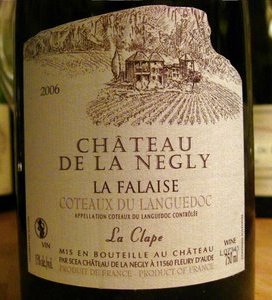
2006 Chateau de la Negly, La Clape
La Falaise (Coteaux du Languedoc)
$43    **BUY THIS NOW**
  • visual:     fully intense inky black-purple core with slight cherry/brick rim
  • nose:     fully intense; youthful showing slight age; layered; bright fresh red berries burst on the nose with cherry & raspberry from the Grenache, followed by a spicy pepperiness which is Syrah... leathery oak is a rich background from the new French oak (50% for 12 months), darker berries come through at the end with some slight heat from the alcohol and a dustiness from the terroir
  • palate:     0 dryness, moderate- acids, moderate+ soft supple tannins, moderate+ rich creamy body, moderately intense flavors; showing some age; layered; surprisingly it is the terroir that dominates the palate: dry dusty earth still full of richness, red and black berries come in with a rush of flavor, and at the end is a beautifully balanced oak structure. Incredibly well balanced for $40, great structure and length. Drinks far above its price.
  • conclusion:   These people know their land and their grapes. A brilliant wine. I know someone who said this could easily be an $80 wine if it weren't from the Coteaux du Languedoc... I don't think he meant it as an insult. If this were from Chateauneuf du Pape.... yea. I would pay $80 for it and feel justified. Power, elegance and richness.
  • Pairs With:    venison scallopini with a fresh thyme demi-glace with the barest hint of chevre cheese in it... steamed carrots tossed in wildflower honey... the slight gamey qualities of the wine will play well against wild meats and the rich acids and tannin crave a bit of fat


Chateau Negly


     My thanks again to http://www.marquis-wines.com/ and http://www.justgrapeswine.com/ for being so free and easy with their accumulated knowledge. Its said, that when a wine it made well, it ends up giving a sense not only of the land it was made on - but of the winemaker as well. I believe, after almost a year of school, after reviewing over 700 wines and writing over 100 articles, that perhaps I am starting to get the barest sense of that.

    Whether it be a $10 bottle or a $100 bottle (or higher!), the wine does tell a story, if it's made well. I feel honored, that so many people in the industry are allowing me to bumble my way through the long process that it is to understand wine. Then I feel doubly honored, when I taste a wine and truly can sense the vignerons *(winemakers) efforts. Its a beautiful thing, really, that someone on the other side of the world could have worked so hard last year or 5 years ago or 25 years ago - so that tonight I could have a special moment of peace.

     It's a kinda magic.


CIN CIN !!!   SLAINTE !!!   CHEERS !!!

Value Priced Cigars, ARGYLE

Ever want a deal? Of course you do - and so do I. I look for deals all the time; on wine, on food and of course on cigars.

     But. But I am also a firm believer that one gets what one pays for. A $10 bottle of wine will never surpass in quality what one buys for $100, even if the $10 bottle is better value for the money. Ah the duality of human nature, right? And so it was with some initial reluctance that I purchased 20 cigars online for about $30 CAD from http://www.holts.com/ in the USA.


     Well my daring has paid off, at least in part. I found myself with 20 cigars that I feel more then comfortable giving out as gifts to friends and colleagues, and yet have enough flavor that I am enjoying them on my drive home, or a walk through one of our local parks. Christmas is a wonderful time to take in a brisk walk with your friends and loved ones, especially if you live in a place as truly spectacular as I do.

     So what did I learn? For $30 they could have been a waste of money, but I still would have given them to my 20-something year old brothers and then "presto" not a waste of money at all. Never be completely steered by price - there are values out there in wine, food and cigars just waiting to be found.

Argyle cigar, Dominican Republic
Churchill,         $2/cigar    **Good Value**
Strength: Mild
Wrapper: Connecticut
Binder: Dominican
Filler: Dominican
  • visual:     no obvious flaws in the construction, smooth wrapper, burns fairly evenly, very light ash so try not to smoke it in the wind or you may be covered by the time you get home
  • nose:     light intensity; not much development or layering of aromas; some vanilla, coffee, cream, leather
  • palate:   light intensity; palate mimicks nose
  • conclusion:   these cigars are rolled by the youngest rollers on the line... very hit-or-miss for quality. I've has two in two days and the first was quite bitter for the first 1/4 and then was just a rough flavor. It made me want to sit in front of a campfire and drink some Jack Daniels (and not the good stuff). The second was much smoother - much more even construction - burnt evenly down to the nub and had virtually no bitterness. A lovely inexpensive cigar that smoked well above it's price!