The Wine Tasting Circle of Vancouver
Vancouver in August can be a garden of riches; the surf rolling gently into Spanish Banks, the warm glow of fading sunlight bathing West Vancouver in the evening, and of course the new Wine Tasting Circle held in the private dining salon of Cibo restaurant/Uva winebar downtown.
Poetic license taken too far?
Perhaps – but these were certainly my thoughts as I sat at the bar of Uva with a friend and waited for the evening to begin. Beautiful people walked past on their way to the beach, or a perfectly situated patio to savor the setting sun and the delicious warmth of summer. We watched and began to lament the lack of well-constructed wine tastings; where oenophiles of every level could come and grow their wine knowledge… banter over a good glass of vino, a plate of tidbits to nosh on, and a cozy corner to do it in.

But that was why I started this Tasting-Circle in the first place! If you hunger for something, and you can’t seem to find it, don’t be afraid to create it yourself. And what a decidedly strong start to our new monthly regime:
2000 BORDEAUX
6 wines from 6 AOC
We started with a classic Haut-Medoc; Bernadotte. www.Chateau-Bernadotte.com The more I learnt about the winery in my research, the more impressed I became! Owned by Madame de Lencquesaing, the owner of prestigious Pichon Longueville Comtesse de Lalande, the property has had millions upon millions of Euros invested in it over the past 15 years.
Of particular interest to me was the intense scrutiny they placed upon their soil-analysis. Of course, we say that it makes sense! A grape grows because of it’s soil, but I also know that not all wineries take the time, the energy, the investment of money to create a fully developed analysis. And what was the result of their work? 35 HA of vineyard sub-divided into plots that are picked (by hand, naturally) by a brigade of 75 professionals.
2000 Bernadotte
 91 points
50% Cabernet Sauvignon, 44% Merlot, 4% Cabernet Franc, 2% Petit Verdot
Maturation: 12-16 months in 30% new French oak
Production: 11,000 cases
- visual: solid garnet core with substantial brick/orange in the rim
- nose: medium+ youthful characteristics of sous-bois (forest-floor), bright red berries, musky wood tones
- palate: medium+ to full young red currant/red raspberry acid, medium+ grippy tannin, medium intensity and developing palate that matches the nose well. Very good balance, very good structure and medium+ length. Alcohol at 13% was particularly well integrated
- conclusion: If you have this, drink it now! We found the berry-notes, so energetic upon opening, faded to nothing in the matter of an hour. After two hours, the wine was lack-luster and suitable for cooking
Then we moved onto a small, old-school producer in St Estephe: Croix de Marbuzet. Tragically (for me), even my exhaustive research could dig up very little that was truly of interest other then the fact that this is a small producer, with limited sales outside of niche-boutiques in England and France.
2000 Croix de Marbuzet
 91+/92 points
60% Merlot, 40% Cabernet Sauvignon
- visual: light ruby core with substantial orange/brick rim
- nose: medium concentration of fresh red berries, some wood and gravel tones… this wine really needed some coaxing and was the one wine that merited a solid one-hour decant minimum. For aeration I would have run twice through the aerator into a decanter. After an hour to an hour 30, we discovered the wine was revealing layers of fresh and drying fruit, complex minerality, savory musky wood tones… truly delightful
- palate: much the same on the palate; 15 minutes after decanting the wine seemed innocuous/flaccid, but after 90 minutes was evolving into a graceful creature: restrained and yet intact medium red and black currant acid, medium chewy tannin, medium- alcohol (12.5% ABV), medium+ concentration of developing flavors that are perfectly inline with the bouquet. Very good balance, excellent structure, medium+ length
- conclusion: the sleeper of the bunch! All of us we much impressed with how elegantly it kept developing for hours. I would say that this has years left in it, but will not develop further. Enjoy 2013-2018
From St Estephe we moved East to Listrac-Medoc and the eminently respectable Fonreaud ( www.ChateauFonreaud.com ). As my regular readers as well aware, environmental sustainability in the wine industry is particularly dear to my heart. As such, it was encouraging to learn of the long history in the vineyard of the “Cousine Methode” which, to me, is just a form of ancestral farming/viticulture.
In fact, this vineyard is so old (by North American standards) that when the AOC system was created, it actually split the vineyard in two; dividing it betwixt two different AOCs. This particular portion is placed on a high gravel terrace with a thick clay and limestone sub-soil which is particularly beneficial in dry summers.
2000 Fonreaud
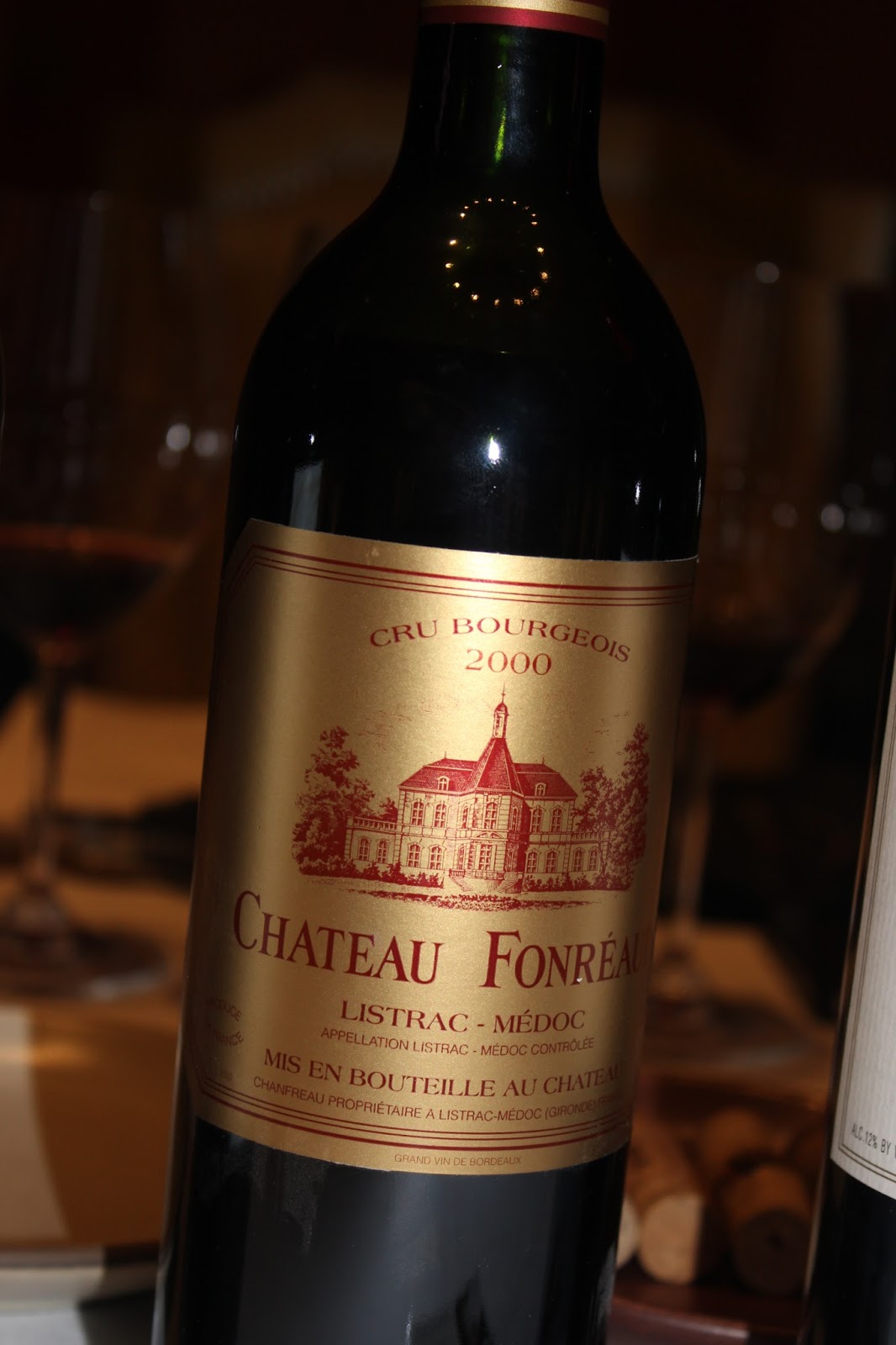 89 points
All lots picked, fermented and matured separately, then blended
12 months in new French oak (percentage unknown)
- visual: solid ruby core, slightly brick rim
- nose: medium+ to fully intense and developed bouquet of savory herbs, musk, spice tones, warm earth, a myriad of berry tones: red and black cherries, raspberries
- palate: medium- to light raspberry acid, medium- silky tannin, medium- developed flavors that match the aromas but with less vigor, good balance, very good structure, medium- length
- conclusion: once again, a great vintage to drink now should you have any left. The acid is fading, the tannins are mostly gone as is the concentration. Still a beauty, but a fading one.
From Listrac-Medoc we moved to an under-represented AOC in the BC market: Premier Cotes du Bordeaux. One of the largest AOC, it runs from the beautiful river-port city of Bordeaux south for about 50 km to Cadillac (home of the famous oak forests). About 5 km wide at it widest span, the Cotes contains a plethora of soil types; from limestone to clay to gravel and everything in between. Geography is everything! And one of the most interesting things about this area is the diversity in grape varietals; from the expected Cab-Sauv and Merlot to the rambunctious Cab-Franc and Petit Verdot to one of the last areas still planting Carmenere in Bordeaux. Carmenere of course, finding great success in Chilean soil, is a delight and though I couldn't find any hard evidence to support my theory, I believe there was/is some in this next wine...
2000 Chateau Saint Yves
 90 points
 90 points
- visual: very pale ruby core with highly oxidized brick rim
- nose: medium+ developed aromas of warm musky wood, forest-floor in Summer, Winter spices
- palate: medium+ raspberry acids, medium meaty/chewy tannin, medium+ concentration of developed flavors that match the nose exquisitely, excellent balance, great structure, medium- length
- conclusion: this wine held it's own quite well after being open for two+ hours. For that reason, in collusion with my tasting notes, I would guess several years of life left - though no further development. Enjoy 2013-2016
And then we crossed the river... from Left Bank to Right Bank is sometimes viewed more as a shift in philosophy, a subtle (or not so subtle) re-alignment of ideology, rather then a geographical movement. From the Cab-Sauv dominated blends of the Left; filled with pencil shaving-graphite aromas and flavors of old leather, warm earth and crisp red berries we enter the world of the Right; full and nuanced red fruit compote bouquets mixed with subtle wild-herbs and tea-leaves.
And if one thinks of the best of the Right Bank? One must then think of iron-rich pockets of sandy-soil, bringing to these (fairly) Northerly wines a roast-beef tinge similar to the best of that wildly famous Southern cousin: Chateauneuf du Pape.
Here I found myself in luxury; a small producer from Pomerol who happens to have that blessed mixture of iron and sand top-soil ( http://www.jbaudy.fr/#/monregard/ ). The 1.3 HA vineyard has been a family project since its purchase in 1924, and is proud to state categorically that they hold 7,500 vines of Merlot. Not one more, not one less! This is a wine to the dilettantes who rant from their pulpits that the Merlot grape is incapable of producing true depth, true substance.
2000 Chateau Monregard la Croix
 91+ points
consultants: Michel Rolland and Christian Veyrey
average vine age: 35 years
maturation: 18 months in 30% new French oak
production: 500 cases
- visual: medium+ ruby core, light cherry/oxidized rim
- nose: medium+ to full concentration of developing classic aromas of ferrous/iron/roast beef, warm cherry compote with a trail of scrub-brush on a warm day
- palate: medium red cherry acid, medium+ chewy/grippy tannin, medium+ concentration of developing flavors that are very much in line with the nose; the bright red berry tones dance on the palate, followed by warm savory sous-bois tones.... continually evolving! A natural to pair with dark chocolate :) ... Great balance, great structure, medium+ length
- conclusion: Yes, you can hold onto this wine for several years - but why? This is drinking so sublimely, and kept doing so for well over an hour... Enjoy this wine at it's prime, can drink 2013-2017+
Almost done.
Our magical evening was coming to a close, but we still had one wine left. One more chance to taste the labor of a families work, from a spectacular vintage, over a decade ago. What were you doing in the Summer of 2000? I remember that year, that Summer, and smile. I was on top of the world and had no idea that it could ever be better.

The Massonie family of Lalande de Pomerol know this as well as any, for they've been working this land since 1890 ( http://www.chateauperron.com/histoire-chateau-perron-perron-la-fleur-vignobles-mp-massonie.pdf ). Starting as negociants in northern France, the family developed a brand that has inspired a cult-following. At least 10% of all of their production is sold immediately to personal clients; mostly in the areas surrounding Reims, Bethune and in Belgium.
2000 Chateau Perron
 90+ points
80% Merlot, 10% Cabernet Sauvignion, 10% Cabernet Franc
soil: sand and gravel subsoil with iron pockets
average vine-age: 45 years
harvest: 100% a-mains (manual), 2 triages
maturation: 12 months, 30% new French oak
production: 12,000 cases

 90+ points
80% Merlot, 10% Cabernet Sauvignion, 10% Cabernet Franc
soil: sand and gravel subsoil with iron pockets
average vine-age: 45 years
harvest: 100% a-mains (manual), 2 triages
maturation: 12 months, 30% new French oak
production: 12,000 cases
- visual: deep ruby, almost garnet core with slight cherry rim
- nose: medium+ Pomerol-like qualities; less musky then Pomerol, but tons of baked earth aromas, baked fruit compote
- palate: medium+ cherry acid, medium- fine yet chewy tannin, medium concentration of developed flavors that are in-line with the nose; warm berry tones, old leather, good tobacco. Good balance, good structure, medium+ length
- conclusion: a delicious example of region, a superb choice to open tonight as it seemed to be peaking that very evening. No need to rush, but will not develop further, enjoy 2013-2018
And like that - POOF - it was done! The room cleared of people, the servers came to set for the next day, and I was left with the empty relics of our thoroughly enjoyable evening. I was sad then, just for a moment, to see it end.

But then I remembered that Wednesday, 04th September, we'll be delighting in the 2005 vintage of Bordeaux and suddenly I felt on top of the world again! Please come and join us - tickets are available on www.LocalWineEvents.com
As always, I look forward to your thoughts here, or on Twitter @ AStudentofWine
CINCIN~!!! SLAINTE~!!! CHEERS~!!!


