I didn't think that I would be writing an article about sherry production, but how does one write about sherry without talking about production?
The world of sherry is a new an exciting one to me, being from Western Canada. Sherry consumption (such little as there is) is usually reserved for old matriarchs who sip contentedly during Christmas on a dram of Harvey's Bristol Cream. Far be it (very far indeed) for me to put forward my much maligned notions on cream sherry, but suffice it to say that I have never been, nor expected myself to become, a sherry drinker.
At least, not until I myself come a matriarch, which I consider most unlikely.
Lo and behold, "the times they are a'changin". I have consumed sherry, willingly, and enjoyed it! I had an upcoming lecture and, as always, fear of being embarrassed by my lack of knowledge made me pick up a few bottles at my local BC Liquor Store (http://www.bcliquorstores.com/).
First on the hit-parade was a little number known as a dry Amontillado, and here is when I must say a little something about sherry production.
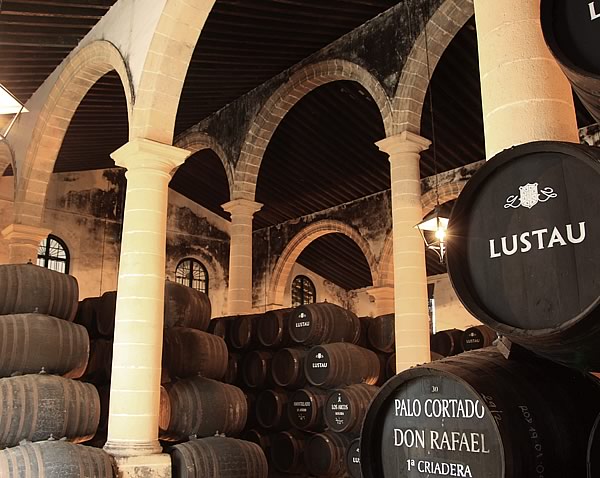 |
| Lustau casks |
Firstly, sherry is made using a method of production known as the solera-system. This is a system by which three layers of large barrels are stacked on top of each other. The top layer is the youngest aged sherry, the bottom layer is the eldest. Each bodega or winery has it's own system, but in general every 4 months to 2 years the bodega will move about 15% of the wine down to the next level. The wine then takes on the characteristics of the older wine in the barrel, and magic is made. When the sherry is ready to move on from the bottom level, it's time to put the magic in a bottle.
An important part of the magic however, lies inside of the sherry casks themselves. Sherry comes from a very moist part of Spain... yeasts and molds are abundant thankfully. I say "thankfully" because one of those yeasts lives inside of the sherry casks. It is responsible, in large part, to giving fine sherry it's distinctive flavors and aromas. Amontillado starts it's life with that flor or yeast, but then the flor dies and what is left behind begins to oxidize in a completely beautiful way.
 |
Lustau reserva Dry Amontillado, Los Arcos Sherry
Jerez de la Frontera, Jerez D.O., Spain
18.5% ABV, $15 (375 ml) **Very Good Value**
- visual: clean; moderate+ caramel core with slight watery rim
- nose: clean; moderate+ intense developed aromas of toasted almonds, soft wildflowers in the background, rich sea salt, raw walnuts
- palate: clean; ultra-dry, moderate+ (young crabapple) acids, moderate+ ABV, moderate+ body, moderate+ intense developed flavors of lemon and yellow grapefruit zest, toasted and raw almonds and walnuts, slight white pepper finish, sea salt, light caramel nuances. Very good balance and structure, excellent finish (for the price)
- conclusion: Great value for the money. Enjoy now - cellaring will have no effect
- PAIRINGS: popular opinion is to serve this with a beef consume. While I can envision the wisdom of this, I would add some heirloom tomato and fresh pasta... but please, enjoy this wine in the warmth! This is not a wine made for cold weather, at least, not for an Irishman like myself
So I learned a little something, tried something new, and still got to prepare for my lecture. Sherry really is something special, and has it's own type of magic in the fermentation world. Most sherries are aged for years before they make it to market, and I have in the past been reluctant to give a few moments to taste a new sherry instead of returning to a wine I know. Who am I to be so reluctant with a few moments when someone has dedicated years for my eonological pleasure?
 |
| Lustau bodega in Jerez de la Frontera |
As always, I welcome your questions and comments.
CINCIN~!!! SLAINTE~!!! CHEERS~!!!


