Showing posts with label braised lamb shank. Show all posts

Saturday, November 10, 2012

Citerna Nero di Troia or Uva di Troia

I love a good deal; a good deal on a suit, a good deal on a flight, or a good deal on a bottle of wine.

I adore a good deal on a great bottle of wine~!!!

Recently I had the good fortune to win an auction for a modestly priced back-vintage of an obscure varietal: Nero di Troia which runs by the pseudonyms Uva di Troia, Uva di Canosa, Uva di Barletta, Uva della Marina, Troiano, Tranese and also Sumarello. A heck of a lot of names for a wine that 20 years ago only had a half-dozen single varietal bottlings. Period.


Well much research has gone into this Puglian grape recently, and the number of single-varietal bottlings has grown to over 80. Certainly, in the grand scheme of Italian wines, this makes it still an obscurity to say the least, but Puglia is taking interest in it's heritage. The Nero di Troia has been planted in "the heel of the boot" for centuries, but has remained a blending varietal for most of that time: this is a grape that tends towards high tannin structure and harvests late in the season. Oh, it has it's benefits as well; (otherwise I doubt it would have lasted) most notably a generous yield and resistance to many diseases, but this was a grape that needed someone to devote some time to it before it would yield it's secrets.

Secrets? Yes... Nero likes it's yields kept low, it needs to ripen fully, and loves a touch of altitude when planted. And it was the professor Luigi Moio of the University of Naples who devoted himself due to the generous benefactors Tenuta Rasciatano. And when the professor opened this door into a new and evolved version of Nero, the winery Tenuta was one of the first to reap the rewards.

Gone was the erstwhile varietal full of over-eager tannins and green herbaceous tones, and in it's place a fresh yet balanced fruit-laden wine brimming with an approachable sense of place. And all for a reasonable price.

Bravo professor~!

2007 Citerna Nero di Troia, Puglia IGT
by Alberto Longo www.AlbertoLongo.it
$10 USD+tax, Tamalpais Wine Agency of Richmond, CA
$25 CAD (not widely available)
89+ points

soil type:    loamy sand texture, mostly calcereous
vines:      single vineyard, family owned'
harvesting:   machine
altitude:    500 metres+
vinification:   cold soak maceration of 10 days usually (kept short to avoid excessive tannins)
maturation:   3 months+ in stainless steel, then 3 months+ in concrete vats, then 3 months+ in bottle
  • visual:   clean; fully intense garnet core (much like Nero D'Avola) with slight bricking to the rim after 5 years
  • nose:   clean; medium+ intense and developed aromas of drying cherries, graphite backbone, bramble fruit, dark flowers... a wine starting to speak of maturity, but in an elegant manner
  • palate:   clean; dry, moderate+ (red and black cherry) acids, moderate+ (chewy, sustained) tannins, moderate+ body, moderate+ to full alcohol (13% ABV), moderate+ intense and developed/ing flavors that mimick the nose; bright red fruit dominate the beginning of this charming table wine, a strong sense of place comes from the mineral/graphite tones that follow, which is summed up by the drying nuances of cherry and floral. Very good structure and balance, moderate length
  • conclusion:   an excellent buy for it's price (in the US), this is still a table wine - just a good one. This can cellar well for up to 5,6 or even 10 years from date of bottling but will start to lose force after 5 or 6.
  • FOOD PAIRINGS:   soft like a Merlot, yet full of vigor like a Malbec, this is a wine I've not experienced before but plan to delve into as often as I can~! When you find a bottle with a few years of age, consider enjoying it on it's own, or with simple charcutterie (cold cuts and cheeses). In it's youth I would pair this with rich beef dishes such as braised oxtail stew or a beef and wild mushroom canneloni... the vivid tannins will appreciate the counter play!

In ancient times it was the hero Diomedes who conquered the legendary city of Troy. He left the smoldering ruins and crossed the (at the time) vast sea to come to hills of Puglia, settling in what became the town of Troia. Some would surmise that he would have carried treasure, and most certainly would have brought food and wine for the voyage. Maybe, just maybe, he also brought a few clippings from local grapevines.

Maybe, and maybe not, but it makes a good story. No matter what the story is behind the history of Nero di Troia, we can be assured that whilst vintners like Alberto Longo are producing quality like this, there will most certainly be a future for it.


You doubt me dear friend? The proof, as always, is in the glass!

Many thanks to wikipedia and Sally Easton, MW at www.WineWisdom.com for their research. I look forward to your comments and questions.


CINCIN~!!!     SLAINTE~!!!     CHEERS~!!!

Tuesday, December 13, 2011

Xumek Reserve, San Juan, Argentina

There is a hot, dry wind blowing through the San Juan province of Argentina. It blows down from the arid mountains; blasting the poor soil and taming the vegetation into subjugation.

   It is the Zonda.

   Zonda is the name for both the wind that blows relentlessly from May through November and also the valley that it lives in. It is this place, the Zonda Valley, that some of the most exciting viticulture in Argentina is taking place today.


  Looking at San Juan province, it is located about 200 miles north of Mendoza province, which wine-lovers the world over have been falling in love with for the past decade or more. Mendoza is home to over 1100 wineries and is the largest wine production area in the country. San Juan is the second largest producer of wine not only in the country, but in all of South America... an area known recently more for it's oil and mineral exploration then for it's viticulture, San Juan is now a hotbed for winemaking activity .

   And in that valley named Zonda, in the southern part of San Juan resting against the mighty Andes mountains, in the very upper reaches lies the relatively new winery known as Santa Sylvia. It was started by the Ezkanazi family who, in Argentina, are better known once again for mineral exploration then they are for winemaking... at least that used to be the case.

   When Eziquiel Ezkanazi decided to build a winery, he used all of his families' experience in mineral exploration, banking, engineering.... what he did he did well and he only hired the best people. Among those persons-of-interest is none other then Mr Paul Hobbs~! Paul Hobbs was the wunderkinder who crafted Catena wines into one of the absolute crown jewels of the Argentinian wine industry, starting with them in the late 1980's when Malbec  was a foreign word.

   Now Paul has found himself on the edge of a new frontier; the outer edges of San Juan and a winery that boasts almost 500 acres of vines and almost the same in olives (I'm told the olive oil is extraordinary). Where Paul and Eziquiel can take us with this new adventure I can only guess. My educated guess however, is that this wine will quickly become a fixture in our Malbec oriented firmament.

2006 Xumek Malbec-Syrah
    **** EXCELLENT VALUE ****
running mid-$30 range in BC, speciality wine stores only

100% estate grown, manually harvested
vines planted in 1995
  • visual:  clear; ultra deep (full+ intense) garnet core with slightest cherry rim
  • nose:   clean; fully intense developing bouquet of red and black cherries, blackberries, blueberries, black floral notes like irises, dark cocoa background, light Asian peppercorn finish
  • palate: clean, dry, moderate+ (currant/cassis) acids, moderate+ (smooth, silty) tannins, moderate+ to fully intense and developing flavors that mimick well the nose; emphasis on cinnamon/peppery finish (what I call Asian pepper) and deep earthy undercurrant. Extremely well balanced, excellent structure and long length
  • conclusion:   showing much better then I would ever guess from 11-year vines.. drink now and enjoy this wine is peaking and will last another 18 months to possibly 3 years. Will NOT improve with further aging
  • FOOD PAIRINGS:   all Argentians love barbeque; it's a fact. Well anyone would love a barbeque if it was paired with this wine~! Consider applewood smoked boneless beef rib on fried onion buns with celeriac remoulade and Xumek poached plum tomato


   Worthy of note? Not only did Wine Access magazine (http://www.wineaccess.ca/) vote the Xumek Malbec as the "Champion Malbec of 2011", but the Argentinian Sommelier Association has voted the Xumek Syrah as one of the top 50 wines of the country~! As for the LittlestStudentofWine, she was was so moved by the wine she started yoga a little early.


As always, I look forward to your questions and comments.

CINCIN~!!!     SLAINTE~!!!     CHEERS~!!!

Saturday, November 12, 2011

Heartland wines by Ben Glaetzer

Have you ever gotten together with your friends and done something exciting? Driven to Las Vegas, kayaked to SaltSpring Island, gone windsurfing in Mexico, started a winery...
   Started a winery?!
   Well that's Ben Glaetzer's idea of fun and he managed to wrangle together a posse of like-minded vinophiles such as Geoff Hardy, Grant Tillbrook and Scott Collett. These men are all leaders in their industry in Australia and their names inspire confidence.

   Geoff Hardy is a fifth generation winemaker in South Australia and his children are even now being groomed to take a more pivotal role in his operations. Grant Tillbrook is a number-crunching wizard whose list of consulting jobs in Australian wineries is staggering... wine-making may be an art-form, but without the right numbers to support it, wineries are incredibly expensive propositions. That leaves Scott Collett whose family has been working with wine in the McLaren Vale for 50 years and show no signs of stopping.
   An inspired group of individuals, but I've often heard it said that "too many chefs spoil the soup". In this instance, nothing could be further from the truth, and it must be due in part to it's captain: Ben Glaetzer.
    Ben literally grew up in the wine industry; Ben's uncle John Glaetzer was the second employee at Wolf Blass Winery (see my article on Wolf Blass at http://astudentofwine.blogspot.com/2011/09/wolf-blass-gold-series-shiraz-viognier.html). Ben's father Colin is a renown winemaker who won the prestigious Winemaker of the Year award in Australia. Even Ben's two brothers are winemakers. One could say that genetics came into play when Ben's received the Quantas award for young winemaker of the year in 2004 and was called a "brilliant winemaker" by Robert Parker Jr.
   So what does the award-winning winemaker do? He gathers a team of like-minded individuals and creates the Heartland brand of wines from South Australia (http://www.heartlandwines.com.au/) which still focus on quality, but with value being a high priority and not afraid to take a few risks in the vineyard.
   Great pricing, great quality, and all from one of the most innovative winemakers in Australia today! What else do you want? Well I for one want to be able to drink the wine right away - as opposed to Ben's ultra-premium Amon-Ra which deserves ample cellaring. Done. All of these wines drink superbly right away and right from the bottle - I didn't even need to decant.
   So what's the magical key to making wines like this: is it only due to the efforts of the massively gifted confederates? Much as some might like to say "yes", the truth is that terroir plays into the equation just as much (if not more) then anything else.
vineyards in Langhorne
   Heartland wines are grown on two distinct properties; in the Langhorne Creek and on the Limestone Coast. The Langhorne Creek is about 70km, or an hour's drive, south-east of Adelaide in South Australia... it's a beautiful place that has been producing wine longer then almost anywhere in this country. Settlers came here in the early 1800's and by the 1850's a wine industry was already bustling. The area is known for the cooling effects that the local lake Alexandrina has on climate, and has been recognized as a "cool-climate" viticulture region.


a stickleback tree on the Limestone Coast
   The Limestone Coast is almost 300km south-east from Adelaide and shares more in common with it's famous neighbour to the east: Coonawarra. The Limestone Coast soil has a high amount of oxidized iron in it's soil, creating what is known a terra rosa or red-soil. The region is also known as having very dry (even by Australian standards) summers which leads to stress on the vines... this stress is good stress, not like when your boss tells you that he's fired someone else in your department and left all of their work for you. This stress leads to reduced yields from the vines which means that there will be a greater concentration of flavors.
   So Ben, Geoff, Grant and Scott decide that they want to use their powers of oenology for good in the world and create unique, well-crafted wines for a reasonable price. How to accomplish this? They source out regions which don't have aren't as well-known yet so they can afford to sell the yields for modest fees. The results speak for themselves.
2009 Heartland Stickleback Red
 $18   *** Very Good Value ***

Varieties: Cabernet Sauvignon 45%, Shiraz 38%, Dolcetto 9%, Lagrein 8%
Region:    Langhorne Creek 67%, Limestone Coast 33%
Vinification: fermented on skins for 5 days before pressing.
                      Malolactic fermentation in 2 and 3 year old oak barrels
Maturation: 12 months in 2 to 3 year old; French and American oak
  • visual:   clear; fully intense plum/garnet core with slightest cherry rim
  • nose:   clean; moderate+ to fully intense developing aromas of red and black currant, red and black raspberry, blueberries, slightly spicy earthy terroir
  • palate:   clean; dry, moderate+ (red raspberry) acids, moderate+ (soft chalky) tannins, moderate body, moderate+ alcohol (14.5% ABV), moderate+ intense youthful flavors that mimick well all the red and under ripe berry notes.... the Shiraz makes its presence known with the spicy finish and the Langrein helps with the fresh acids. Very good balance, and structure, medium+ to long length
  • conclusion:   drinks well now but can cellar easily for until 2014. Will not develop appreciably
  • FOOD PAIRINGS:   crisp red wines need a bit of fat; pair this wine with a Grilled ribeye steak with kosher seasalt and smoked paprika rub

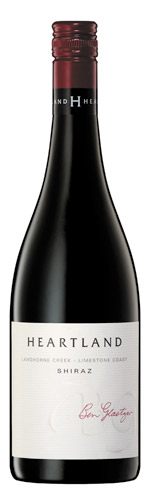
2009 Heartland Shiraz
$25   **** EXCELLENT VALUE ****
Varietal: 100% Shiraz
Region: Langhorne Creek 95%, Limestone Coast 5%
Soil: Langhorne Creek: Sandy Loam, Limestone Coast: Grey marl over deep limestone
Age of vines: 16-18 years
Vinification: crushed, then pumped over twice a day. Ten days skin contact. Extended maceration
Maturation:  14 months in new to 4 year old; 70% French, 30% American oak hogshead barrels
  • visual:   clear; moderate+ bruised plum/garnet core with slightest cherry rim
  • nose:   clean; moderate+ intense and developing aromas of red berries, spicy black licorice (no, really, that's what it smells like to me), dark espresso and chocolate notes
  • palate:   clean; dry, moderate+ (raspberry/currant) acids, moderate (soft, silky) tannins, moderate+ intense and youthful flavors mimicking well the nose with emphasis on red currant, red raspberry with the spicy finish known for Shiraz. Very good balance, excellent structure with long length
  • conclusion:   drinking well now, this wine will certainly reward cellaring for the next several years. Drink 2014-2018
  • FOOD PAIRINGS: a natural for lamb with it's lively acids, consider braised lamb shank with prosciutto-tomato and fresh sage reduction over parnsip and Yukon Gold potato mash

2009 Heartland Cabernet Sauvignon
$25    **** EXCELLENT VALUE ****
Varietal:  100% Cabernet Sauvignon
Region: Langhorne Creek 73%, Limestone Coast 27%
Soil: Langhorne Creek: Sandy Loam, Limestone Coast: Grey marl over deep limestone
Age of vines: 12-15 years
Vinification: crushed into 10 tonne open fermenters, and left on skins to cold macerate for three days prior to yeast inoculation. The wine was pressed to oak for malolactic fermentation, then racked and returned to oak
Maturation:   12 months 2 to 4 year old; 80% French 20% American oak
  • visual:   clear; fully intense garnet core with cherry rim
  • nose:   clean; fully intense developing aromas of blackberry, warm winter spice, light tobacco and cigar box, light eucalyptus or menthol notes
  • palate:   clean; dry, moderate+ (red raspberry) acids, moderate+ to fully intense (soft, chalky) tannins, moderate+ body, moderate+ alcohol (14.5% ABV), moderate+ intense and youthful flavors mimicking the nose once again with emphasis on the red berry notes and a lingering earthy background... the terra rosa shows through. Excellent balance and structure, long length
  • conclusion:   drinking well now, this wine also benefits from cellaring. Drink 2014 to 2018
  • FOOD PAIRINGS:   rich red wine with a bit of zippy acids? Consider a Butter poached beef tenderloin with slightly spicy roast garlic compound butter

Heartland wineries on the map


   And so I'm left at the end of a truly wonderful tasting asking the exact same question I did at the beginning. Which is mightier in winemaking: the winemaker or the terroir? Obviously the answer is more complicated then just black or white.. it's neither one nor the other. The truest joy in winemaking comes for the consumer when winemaker and terroir are working in unison as evidenced by the above.

   My joy these days is measured by the LittlestStudentOfWine, who gave her smiles of approval when she smelled each and every one of these wines. My smiles were not far behind...

As always, I look forward to your comments and questions.

CINCIN~!!!     SLAINTE~!!!     CHEERS~!!!

Monday, August 8, 2011

Rosemount Estate Balmoral Syrah

In the 1860's a young man from Germany came to the unknown; he came to Australia. Landing in the new seaport of Sydney (which had functioned as a port for the Aboriginal people for 30,000 years) Carl Brecht was determined to set his own future, and followed a little known road to the outer edges of the Hunter Valley. There, at the junction of the Wybong Creek and the Goulburn River he planted his vineyard and settled the savage land.


    Fast-forward 100 years and another entrepreneur comes along in the Australian world of wine. In 1968, a visionary by the name of Bob Oatley purchased the long-standing vineyard of Rosemount Estate (www.RosemountEstate.com.au). Rosemount had enjoyed a lengthy position as one of the fine wine producers of Australia, but Bob wanted to take it further: he wanted to be the best. A worthy dream, but necessitating a rather huge amount of work, n'est-pas? Bob was up to the task of fulfilling his vision.

   In 1975 Rosemount released their first wines; a 1974 Hunter Valley Semillion and Hermitage. They garnered a total 69 awards throughout Australia. Enough to qualify as being the best? In 1982 they took their 1980 Chardonnay and became the first Australians to ever with double-gold at the International Wine and Spirit Competition. Enough yet to feel like the best? In 1999, Rosemount became the first non-American winery to ever win winery of the year at the prestigious San Francisco International Wine Competition.

   One would think that perhaps Bob would rest on his laurels.

   One would be wrong.

   In 2004 the 2002 Diamond Merlot wins the Merlot Trophy at the International Wine and Spirit Competition; one of the most highly recognized trophies for a varietal.

   Bob Oatley has taken one property in 1966 and turned it into several properties ranging the width and breadth of the winemaking spectrum in both South Australia and New South Wales. One of the jewels in this crown would be the Balmoral Syrah produced in the McLaren Vale. Anyone who wants information on the discovery and formation of this part of South Australia, approximately 45 minutes drive north of Adelaide should read some of my earlier articles ( http://astudentofwine.blogspot.com/2011/02/penfolds-koonunga-hill-shiraz-cabernet.html ).


   The winery in the McLaren in situated on three distinct areas that yield fruit of sufficient quality - the sandy loam soils near Blewitt Springs; the darker soils in McLaren Flat itself; and the red soils with underlying limestone found in the Seaview area (my thanks to www.TheWineDoctor.com ). The vines are generally between 50 and 100 years old, although sources say that there are still some patches over 100. By comparison, most vines in British Columbia are between 10 and 20 years old... the older the vines - the less they produce, but, the more concentrated the flavors. Most wineries will tear out vines before they reach 100 years old as they simply don't produce enough juice to be fiscal responsible. Bravo to the Bob Oatleys and (chief winemaker) Matt Kochs of the world~!

2002 Rosemount Estate "Balmoral" Syrah
$75 CAD  ***** BUY THIS IF YOU CAN *****
14.5% ABV

vineyard:    50 to 100 year old vines (small percentage over 100 years)
maturation:   24 months, American oak
  • visual:   clear; fully intense violet-crimson core with slightest brick rim
  • nose:   clean; moderate+ to fully intense and developed bouquet of drying red berries (red and black cherries, red and black raspberries, blackberries), rich white and slightly floral pink peppercorn, soft background of drying summer flowers, light savory herbaceousness, finish reminiscent of decadently rich dark cocoa
  • palate:   clean; dry, moderate+ (lively and brilliantly integrated red raspberry) acids, moderate (velvet soft and slightly chalky) tannins, moderate body, moderate alcohol, moderate+ intense and developed flavors that mimick the nose perfectly; the red berries burst on the palate with dark cocoa and peppercorn dominating the mid-palate and a ridiculously long finish of the American oak light vanilla notes and soft florals. EXCELLENT balance, structure and long long long length
  • conclusion:   if you have cellared this properly, it is still drinking stupendously and will continue to do so for several years; enjoy this special wine present to 2015/17
  • FOOD PAIRINGS:   I may be a heathen for this, but the depth of this wine's expression of terroir and varietal made me think to South Australian cuisine and culture, and I came up with braised lamb shank on caramelized shallot yam pave with olive oil fried arugula... the reasons for this are long and varied, but based upon drawing similarities from the food to the wine and vice-versa

   As this was my first foray into Rosemount wines, I was duly impressed. I have nothing else to say other then that I can't wait  to try more from the whole winemaking team.

As always, I look forward to your questions and comments.

CINCIN~!!!     SLAINTE~!!!     CHEERS~!!!